

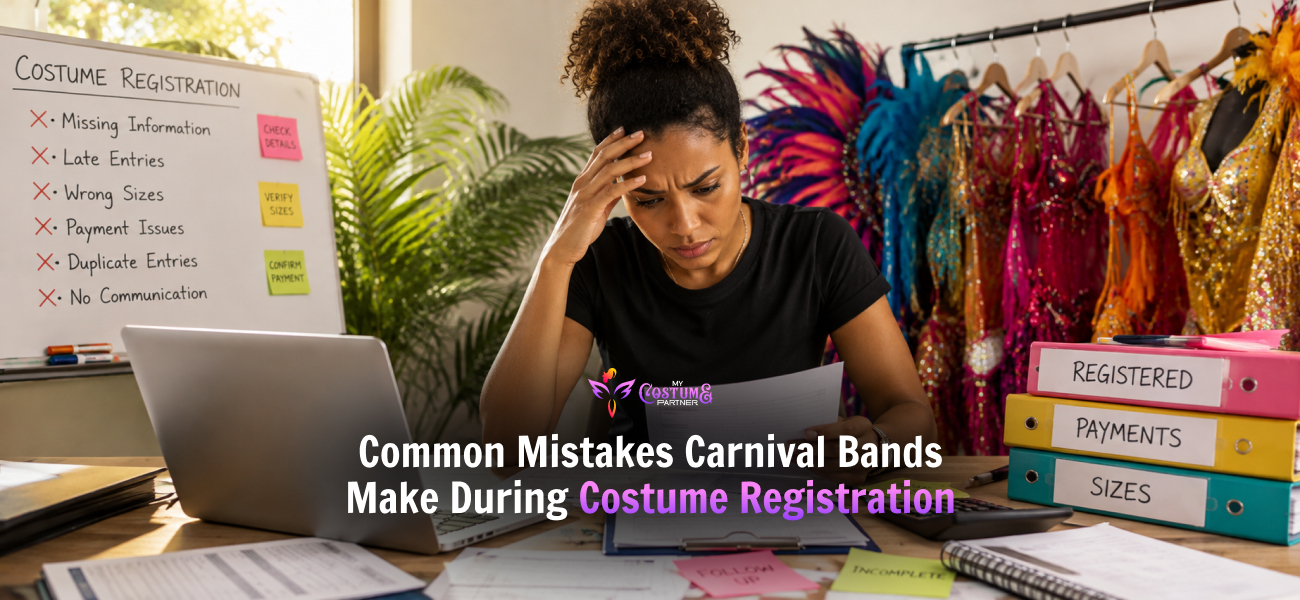
Common Mistakes Carnival Bands Make During Costume Registration
The most common mistakes carnival bands make during costume registration are announcing before the registration link is live, collecting sizing separately from registration, using informal payment methods with no audit trail, setting no visible deadline or capacity limit, and not owning the masquerader data the season generates. Each of these is avoidable with a purpose-built carnival registration platform that handles the process automatically.
Carnival registration season is the most financially important period in a band's calendar. The decisions made in the weeks before registration opens, and the systems used to manage it when it does, determine how smoothly the season runs, how many sections fill, and how much of the potential revenue the band actually collects.
Most of the mistakes that cost bands registrations and revenue during this period are not unique. The same problems appear across bands of different sizes in different markets every season. Understanding what they are and how to avoid them is the difference between a registration window that runs itself and one that requires weeks of manual intervention to hold together.
Mistake 1: Announcing Registration Before the Link Is Live
The announcement is the single highest-intent moment of the registration season. When a band reveals a new section, masqueraders who have been waiting are ready to commit immediately. If the registration link is not live at the exact moment of the announcement, that intent dissipates. Masqueraders who were ready to register in the first hour become people who meant to register and got distracted.
The drop-off between announcement-day registrations and registrations collected in the 48 hours after the announcement is significant. Bands that go live at announcement consistently show a stronger first-wave conversion rate than bands that announce and then share the link a day or two later when the platform is ready.
The fix is straightforward. Build and test the full registration store before any announcement goes out. Section pages, deposit amounts, sizing fields, capacity limits, and the checkout all need to be live and tested on a mobile device before the first post is published. How to sell carnival costumes online covers the full setup sequence that ensures registration is ready before the announcement moment arrives.
Mistake 2: Collecting Sizing Separately From Costume Registration
Asking masqueraders to message their sizing after registration is one of the most common and most costly carnival band mistakes. At small scale, it creates follow-up work. At registration volumes of 200 or more masqueraders across multiple sections, it creates a reconciliation problem that costs hours to manage and produces errors that reach the manufacturer as wrong-sized costumes.
When sizing is collected outside the registration system, some masqueraders never respond. Others respond in a different format than the manufacturer needs. Some send measurements that differ from what they submitted elsewhere. The band leader or registration coordinator spends weeks in a WhatsApp thread chasing confirmations while managing every other aspect of the season simultaneously.
Sizing must be captured at checkout as part of the registration process. When a masquerader cannot complete registration without entering their measurements, the data exists from the moment they register. It is stored against their record in a standardised format and included in the manufacturer export automatically when the window closes. The follow-up problem disappears entirely. How the pre-order model should work end to end covers this data capture step as part of the full production cycle.
Mistake 3: Using Informal Payment Methods With No Audit Trail
Bank transfers, payment apps, and cash collections are still common across Caribbean carnival band registrations. At small registration volumes, these methods function well enough. As volume grows, they create operational and financial problems that are disproportionately difficult to manage.
No Clear Link Between Payment and Registration
When payments arrive through a bank transfer or payment app, the band receives a transaction notification. That notification shows the amount and the sender but does not automatically connect to a registration record. Matching incoming payments to masquerader registrations is a manual process that requires time and produces errors. A masquerader who sent a transfer but whose name does not exactly match the registration record becomes an administrative problem rather than a confirmed registration.
No Audit Trail for Chargeback Disputes
When a masquerader disputes a payment through their bank, the band needs documentation showing what was purchased, under what terms, and on what date. An informal payment through a bank transfer provides none of this. My Costume Partner processes every payment through Stripe and creates a timestamped record that includes the masquerader's details, the section, the amount, and the terms displayed at checkout. That documentation is the difference between winning and losing a dispute. How to prevent chargebacks on carnival costume sales covers this documentation requirement in full.
Mistake 4: Setting No Visible Deadline or Capacity Limit on Costume Sections
A registration with no visible closing date and no visible capacity limit creates no urgency. Masqueraders who are interested but not immediately committed have no reason to act. They can register next week. Or the week after. And then one day the section is closed and they missed it and they are frustrated with the band rather than with their own delay.
Visible Deadlines Drive Registrations
A registration window that closes on a specific, clearly communicated date creates a reason to act now rather than later. Most of the late registrations that come in during the final 48 hours of a window come from masqueraders who had intended to register earlier and were pushed to action by the closing deadline. That deadline-driven behaviour is predictable and reliable. It should be structured into every registration rather than left as an informal expectation.
Visible Capacity Limits Create Social Proof and Urgency
A section that shows how many spots remain creates two effects simultaneously. It provides social proof that other masqueraders are registering, which validates the decision to commit. And it creates urgency, because a section with 18 spots remaining is one that a masquerader who wants to attend needs to act on now rather than later. My Costume Partner shows live capacity counters on each section page and closes registration automatically when capacity is reached. There is no manual intervention required from the band. What to look for in carnival band registration software covers capacity management as one of the core requirements for any platform.
Mistake 5: Running Jouvert Registration Through a Separate Process
Bands that run jouvert alongside their main carnival sections often manage jouvert registration through a separate payment link, a different form, or an entirely different system. This creates split data, double work for the registration team, and a more complicated experience for masqueraders who want to register for both.
Jouvert registrations that exist outside the main registration system are not tracked against the masquerader's main costume record. When it comes to distribution day or communication about jouvert logistics, the band is working from a separate list that may or may not be current or accurate.
Jouvert should sit within the same registration store as main costume sections. Masqueraders register for both in the same session. The data sits in the same dashboard. The export separates the two clearly when the manufacturer file is needed. The entire jouvert operation runs through the same platform that manages everything else. How to sell jouvert packages online covers the setup process in full for bands adding this to their registration store.
Mistake 6: Not Owning the Masquerader Data the Season Generates
This mistake does not show up during registration season. It shows up at the start of the next one. A band that ran registrations through a shared platform discovers that the masquerader database from the previous season sits in the platform's system. Reaching past masqueraders for the new season requires going through the platform's communication tools or starting a marketing campaign from scratch to people who already know and have previously registered with the band.
Every registration season generates an audience asset. Contact details, section history, sizing, payment behaviour, registration timing. That data is the foundation for pre-registration interest campaigns, early access offers to returning masqueraders, and the kind of direct communication that fills sections faster and cheaper than social media marketing alone.
On My Costume Partner, every masquerader belongs to the band's own database from the first registration. The data accumulates across seasons rather than resetting each year. After three seasons on the platform, the band has a masquerader history that makes each new registration window faster and cheaper to fill than the one before. Building and owning your masquerader database covers why this asset compounds in value with every season that runs.
Mistake 7: Using a Platform That Was Not Built for Carnival Registration
General ecommerce tools, shared marketplace platforms, and informal payment link setups all share the same fundamental limitation. They were not built for how carnival bands sell. The pre-order model, the section-based registration structure, the deposit and balance payment flow, the sizing data capture, the jouvert package management, none of these are native features of a general tool. Each one requires a workaround that adds operational complexity and creates a new point where errors can occur.
A platform built specifically for carnival band registration handles all of these as standard. Section listings with independent capacity limits. Deposit collection at checkout. Automated balance tracking and reminders. Sizing capture in a standardised format. Jouvert packages within the same store. A clean manufacturer export when registration closes. All of it running automatically under the band's own brand.
My Costume Partner is built for exactly this model. How to manage costume orders without spreadsheets covers how the platform removes the manual work that informal systems create throughout the registration season.
My Costume Partner is built to prevent every mistake on this list. Get started and have your next registration season running on infrastructure that was built for how carnival bands actually operate.
Frequently Asked Questions
What are the most common mistakes carnival bands make during costume registration?
The most common mistakes are announcing registration before the link is live, collecting sizing separately from the checkout, using informal payment methods with no audit trail, setting no visible deadline or capacity limit, running jouvert through a separate process, and not owning the masquerader data the season generates.
Why do carnival bands lose registrations during the announcement period?
Because the registration link is not live at the moment of announcement. Masquerader intent peaks at the reveal. Every hour between the announcement and a live registration link loses buyers who were ready to commit and got distracted before the process was available.
How should sizing be collected during carnival costume registration?
At the point of checkout as a required step before registration confirms. Sizing collected through messages or separate forms after registration creates a reconciliation burden, produces errors, and leaves some masqueraders unconfirmed in the production data. A platform that requires sizing at checkout captures it accurately for every registration without follow-up.
Why is visible capacity important in carnival section registration?
A visible capacity counter shows masqueraders how many spots remain, which creates both social proof that others are registering and urgency to commit before availability runs out. Sections with no visible capacity signal create no urgency and fill more slowly than they should given available demand.
What happens to masquerader data if a carnival band uses a shared registration platform?
It sits within the shared platform's database. The band receives an export but the ongoing customer relationship and the full data history belongs to the platform. When the next season opens, reaching past masqueraders requires going through the platform's tools rather than a direct database the band controls.