

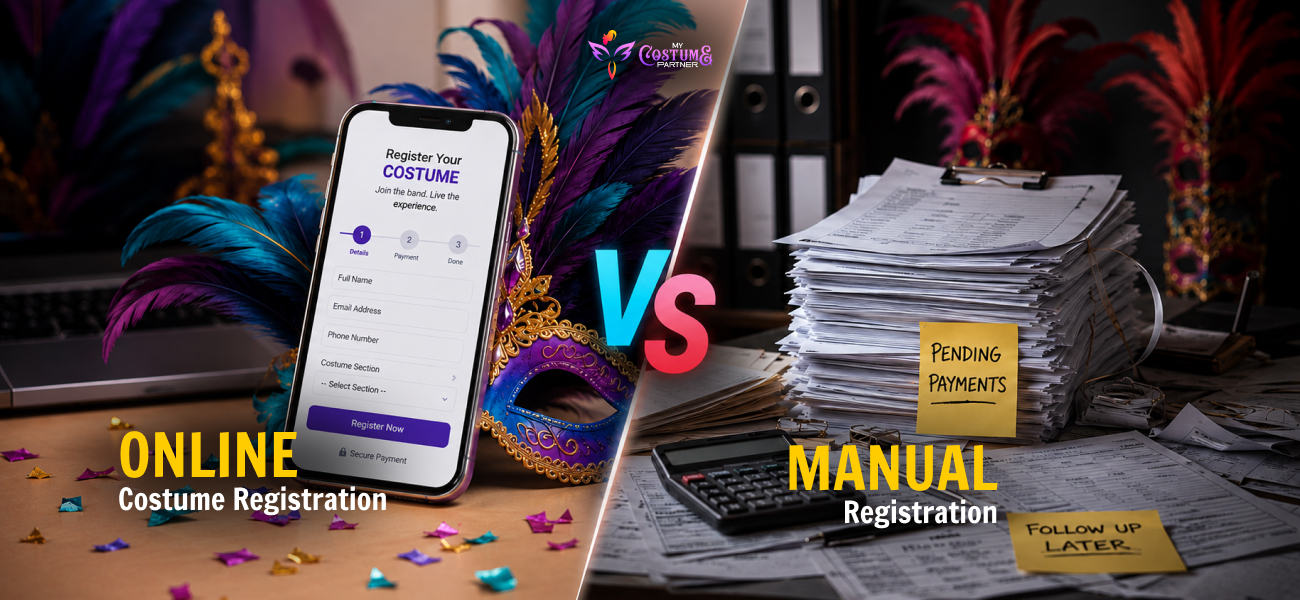
Online Costume Registration vs Manual Registration
Online costume registration beats manual registration for carnival bands on every metric that matters at scale: payment collection speed, data accuracy, sizing capture, balance tracking, masquerader communication, and manufacturer export quality. Manual registration through WhatsApp, bank transfers, and spreadsheets works at small volumes but creates compounding operational problems above 100 to 150 registrations. My Costume Partner is built for online carnival costume registration so the entire process runs automatically from deposit collection to manufacturer export.
Most carnival bands that still use manual registration know it is not working as well as it should. The WhatsApp threads, the bank transfer reconciliations, the sizing forms that nobody fills in, the spreadsheet that has three different versions because two people edited it on the same day. The problems are familiar.
The question is not whether online registration is better. It is what the real difference looks like across a full registration season and whether the switch is as complicated as it might seem. This guide answers both.
What Manual Carnival Costume Registration Actually Involves
Manual registration is not a single system. It is a collection of informal processes that together approximate what a proper registration platform does natively. Understanding the full operational picture of manual registration makes the comparison with online registration concrete rather than abstract.
How Manual Carnival Band Registration Typically Works
A masquerader sees a section revealed on social media and sends a message to the band. The band responds with payment details. The masquerader sends a bank transfer or uses a payment app. The band checks their account, matches the payment to the masquerader, and adds an entry to a spreadsheet. They then message the masquerader to confirm and ask for their sizing. The masquerader replies with measurements at some point, hopefully before the production deadline. The band adds the sizing to the spreadsheet, or a separate document, or a WhatsApp note, depending on who is managing it.
When balance deadlines arrive, the band reviews the spreadsheet, identifies who has not paid, and sends individual messages. When production time comes, someone reconciles the sizing data against the registration list and reformats it into a file the manufacturer can use.
Every step in this process is manual. Every manual step is a potential error. And the time cost of running this process across 300 registrations in a six-week window is significant.
Where Manual Carnival Registration Breaks Down
Manual registration does not fail catastrophically. It degrades gradually as volume increases. The first 50 registrations are manageable. The next 100 are stressful. By registration 250, the band leader is spending a disproportionate amount of their season on administration rather than on event preparation, costume quality, and masquerader experience.
The degradation points are consistent across bands: payment reconciliation errors, missing sizing data, disputes about whether a balance was received, spreadsheet versioning problems, and a manufacturer export that takes days to prepare and still contains entries the team is not confident about.
What Online Carnival Costume Registration Replaces
Every manual step in the process above is replaced by an automatic one when registration runs through a purpose-built online platform.
Online vs Manual Registration: The Key Differences That Matter Most
Payment Collection Speed and Confirmation
Manual payment collection through bank transfers and payment apps creates a delay between when a masquerader commits and when the band has confirmed the registration. A bank transfer that arrives outside business hours may not be checked until the next day. A payment app transaction may be received but not matched to a registration immediately. During that delay, the masquerader considers themselves registered. The band does not know whether to hold the section spot. The uncertainty creates disputes when sections reach capacity.
Online registration eliminates this entirely. Payment processes at checkout in real time. The spot is confirmed the moment the payment clears. There is no delay, no manual matching step, and no ambiguity about whether a masquerader is registered.
Sizing Data Accuracy in Online vs Manual Carnival Registration
Sizing collected manually through messages produces three consistent problems. Measurements arrive in different formats. Some masqueraders never respond. Others respond with different measurements than they gave at a previous in-person fitting. Each discrepancy requires follow-up and each follow-up costs time.
Sizing captured at checkout solves all three. The masquerader enters measurements in a standardised field before the registration confirms. The data is stored in a consistent format against their record from the moment of registration. When production time comes, the sizing data is already in the platform in the exact format the manufacturer needs. How the pre-order model works end to end covers sizing capture as part of the full production cycle from registration to manufacturer export.
Balance Tracking and Payment Reminder Management
Manual balance tracking requires someone to maintain a spreadsheet of who paid a deposit, what balance is outstanding, and when each deadline passes. As the balance deadline approaches, the band sends individual follow-up messages to everyone with an outstanding amount. This process at 30 registrations is manageable. At 250 it is a part-time job.
Online registration handles all of this automatically. The platform tracks every balance in real time. It sends balance reminders according to the schedule the band sets. The band can see exactly who has paid and who has not from their dashboard without reviewing a spreadsheet or sending a single message. How carnival costume payment plans should be structured covers the deposit and balance model that online registration handles natively.
Masquerader Data Ownership After Registration Closes
When manual registration closes, the masquerader data exists in a spreadsheet on someone's device. The quality of that data depends on how carefully it was maintained throughout the season. Contact details may be incomplete. Section history from previous seasons may be in a different document. Sizing from a previous season may not have been consolidated.
When online registration closes on My Costume Partner, every masquerader's complete record is in the band's dashboard. Name, contact details, section, sizing, payment history, registration timing. All of it clean, consistent, and exportable. After multiple seasons on the platform, the band has a unified masquerader database that builds in value with every year that runs. Building and owning your masquerader database covers exactly how this data compounds in strategic value over time.
When Manual Registration Still Makes Sense
Manual registration is not without merit at certain stages of a band's development. For a band running its first season with under 50 masqueraders, the overhead of setting up an online platform may outweigh the operational benefit of automating a process that is still manageable at that scale.
The point at which manual registration stops making sense varies by band but most leaders who have made the switch report that the tipping point was somewhere between 80 and 150 registrations. Above that threshold, the time cost of manual processes exceeds the setup cost of a purpose-built platform within the first season of use.
For new bands starting out, setting up an online registration platform from the first season avoids developing manual habits that need to be changed later and starts building the masquerader database and operational infrastructure the band will need as it grows. How to start a custom costume business online covers the full setup for bands approaching this for the first time.
How to Switch From Manual to Online Carnival Costume Registration
The most common concern about switching from manual to online registration is the complexity of the transition. In practice, the migration is simpler than most band leaders expect.
- Consolidate your existing masquerader data. Pull every registration record, payment history, and sizing data from your current sources into a single clean file. This historical data becomes the starting point for your online database.
- Set up your branded registration store before the season opens. Add your section listings, deposit amounts, sizing fields, capacity limits, and jouvert packages. Test the full checkout on a mobile device before any announcement goes out.
- Communicate the change to your masqueraders before registration opens. A short message explaining that registration is now online, with a link to the store, sets expectations and reduces questions during the window.
- Direct all registration to the online platform exclusively. Do not run online and manual registration simultaneously. A split system creates the same data reconciliation problems you are trying to eliminate.
- Use the dashboard throughout the season instead of a spreadsheet. Monitor registrations, payment status, and capacity by section in real time without building any manual reports.
For bands reviewing the available platforms before making this switch, what to look for in carnival registration software covers every evaluation criterion in detail including the questions to ask any platform before committing to it for your registration season.
Frequently Asked Questions
Is online costume registration better than manual registration for carnival bands?
Yes, above approximately 100 to 150 registrations. Online registration through a purpose-built platform captures payments, sizing, and masquerader data automatically at checkout, tracks balances in real time, sends reminders automatically, and produces a clean manufacturer export when the window closes. Manual registration requires all of these steps to be done manually, which becomes unsustainable as volume grows.
What are the main problems with manual carnival costume registration?
Payment reconciliation errors, missing or inconsistent sizing data, time-consuming balance chasing, spreadsheet versioning problems, and a manufacturer export that requires hours of manual preparation. Each problem compounds as registration volume increases above 100 masqueraders.
How does online carnival registration handle sizing data?
A purpose-built online registration platform captures sizing at checkout as a required step before registration confirms. The data is stored in a standardised format against each masquerader's record and included in the manufacturer export automatically. There is no follow-up required and no manual transcription between what the masquerader submitted and what the manufacturer receives.
How long does it take to set up an online carnival costume registration store?
On My Costume Partner, most bands are live within a day of signing up. Branding, section listings, deposit amounts, sizing fields, capacity limits, and jouvert packages can all be configured through a guided interface without developer support. The store is ready to test before the first announcement goes out.
Does switching to online registration mean masqueraders have to create an account?
Not necessarily. My Costume Partner allows masqueraders to complete registration and payment as guests without requiring account creation. This reduces checkout friction and keeps the registration experience as straightforward as possible for masqueraders who are registering from mobile devices.